I'm a PhD student in Computer Science at University College London, where I work with Chengxu Zhou in the Humanoid Robotics Lab. I study how humanoid robots learn as one task flows into the next, without a reset or a clear boundary between tasks.
Past experience rarely fits a new situation exactly. How can a robot decide what to reuse, act to find out what it doesn't yet know, and try a new approach? What it learns from that attempt should help shape its next decision.
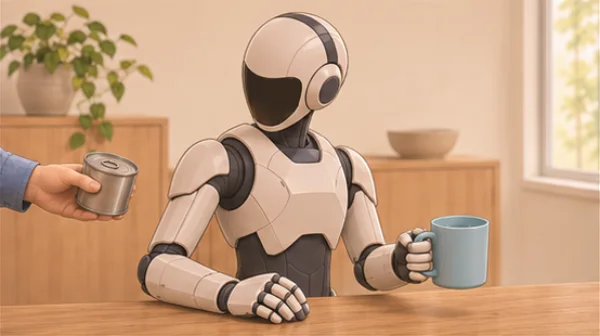
A thought experiment: “Could you open this?”
Look before reaching
Which object does “this” mean? Turning towards the voice brings the tin into view.
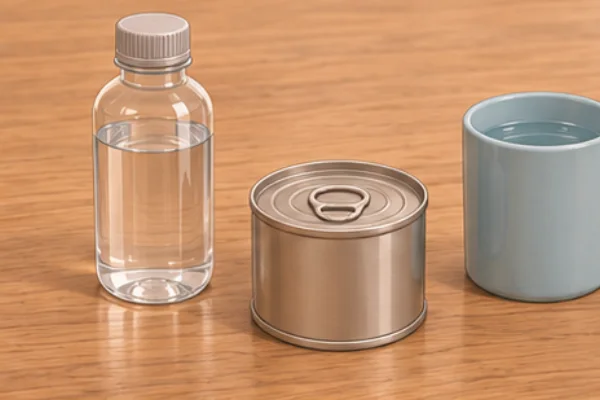
Reuse the grip
Opening bottles taught it to steady the container. That grip still helps, but there is no cap to twist.
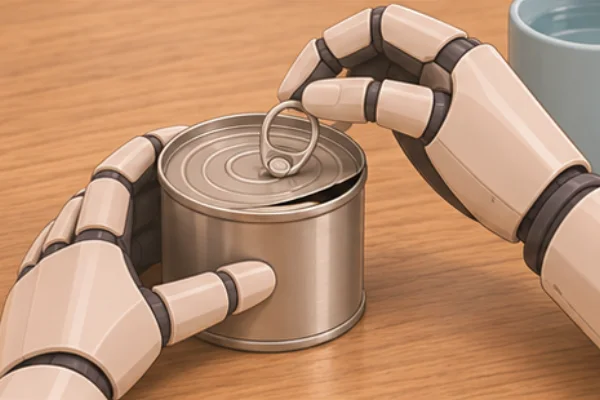
Try a different pull
Pulling flat fails. Lifting the ring opens a gap. Will it try lifting first on the next tin?
Selected research
Ongoing research · Manuscript under review
SPIRE: When does an old motor skill help?
Yiyang Jia, Mingyang Lyu, Gongce Cao, et al.
Can a controller recognise a change of situation and reuse parts of an earlier skill without being told which task it is facing? SPIRE tests this by selectively rewinding what the controller learned before.
Left: one selected pair per task, with prior training (blue) and from scratch (coral). Right: signed motor contributions from that trained run, step by step.
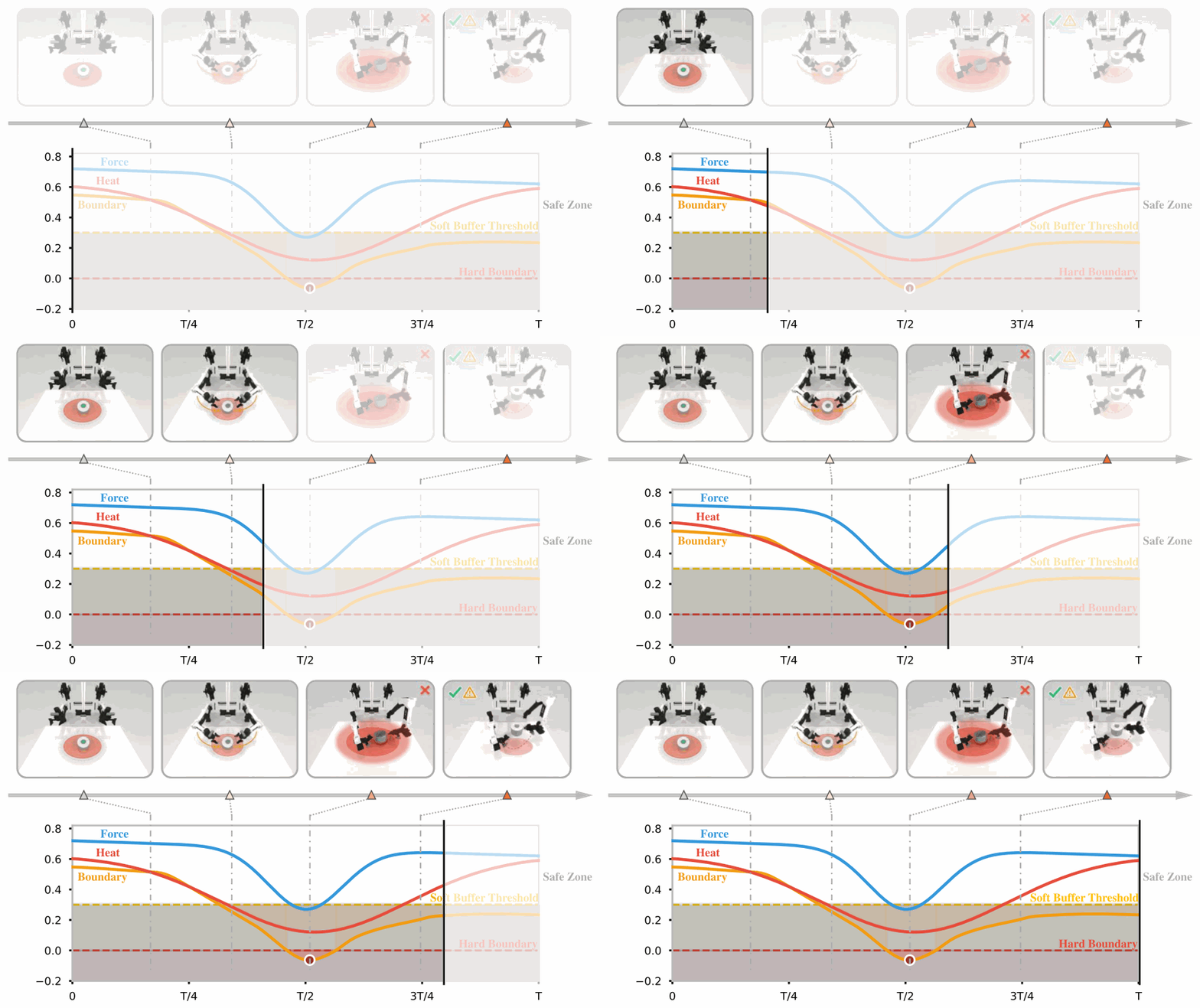
A robot can finish a task and still act unsafely. This benchmark measures what happens along the way across 66 simulated scenarios.
@inproceedings{lyu2026foresightsafety,
  author        = {Lyu, Mingyang and Sun, Yinqian and Jia, Yiyang and Shen, Sicheng and Sha, Moquan and Li, Huangrui and Zhao, Feifei and Zeng, Yi},
  title         = {{ForesightSafety-VLA}: A Unified Diagnostic Safety Benchmark for Vision-Language-Action Models},
  booktitle     = {2026 IEEE/RSJ International Conference on Intelligent Robots and Systems (IROS)},
  year          = {2026},
  eprint        = {2606.27079},
  archivePrefix = {arXiv}
}
Before my PhD, I worked on embodied intelligence at the Institute of Automation, Chinese Academy of Sciences. I hold an MSc in Robotics and AI (Distinction) from UCL and a BEng in Robot Engineering from the University of Electronic Science and Technology of China.